Key Takeaways
A comprehensive analysis of vCISO pricing models and cost savings for small and medium businesses. Learn how virtual security leadership can deliver $200,000+ in annual savings compared to full-time CISO hiring, with real market data from employment platforms and consulting firms.
In today’s threat landscape, cybersecurity has evolved from a nice-to-have to a business-critical necessity. Small and medium-sized businesses (SMBs) face the same sophisticated cyber threats as Fortune 500 companies, yet they often lack the budget for enterprise-level security leadership. Enter the Virtual Chief Information Security Officer (vCISO) – a game-changing solution that delivers executive-level cybersecurity expertise at a fraction of the cost of a full-time CISO.
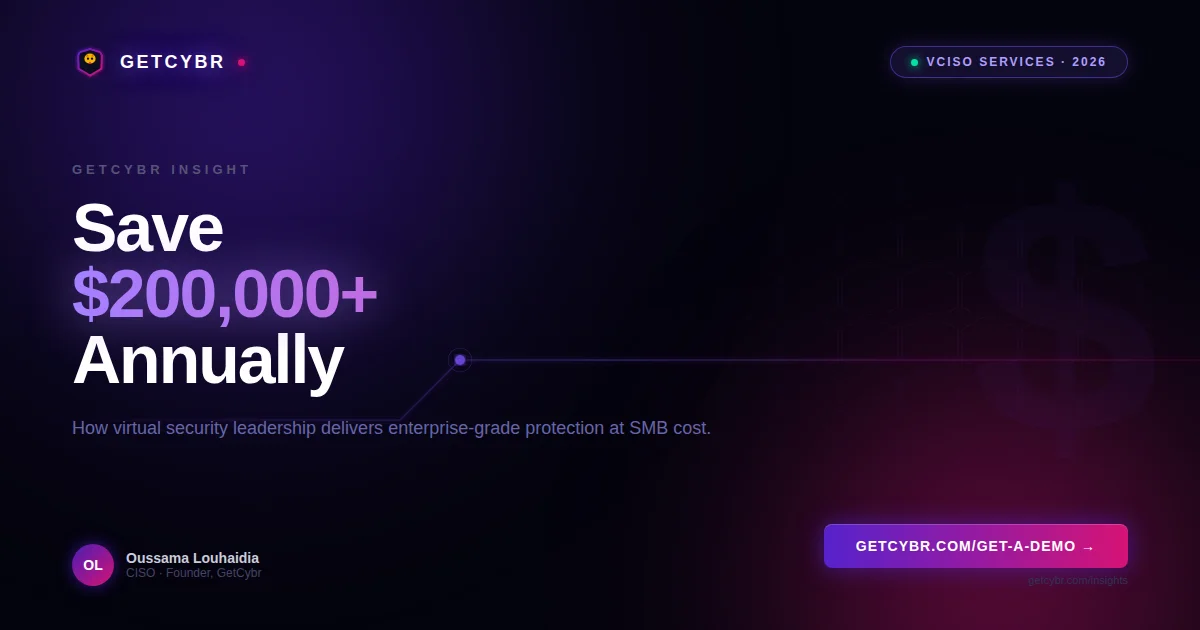
This comprehensive guide examines real-world vCISO pricing models, analyzes current market rates from platforms like Upwork and consulting firms, and reveals how SMBs can achieve savings of $200,000 to $400,000 annually while maintaining robust security posture.
Understanding vCISO Services and Value Proposition
A Virtual CISO provides strategic cybersecurity leadership without the overhead of a full-time executive position. Unlike traditional consulting that focuses on specific projects, vCISO services offer ongoing strategic guidance, risk management, compliance oversight, and security program development.
Key vCISO responsibilities include:
- Providing executive-level reporting to boards and stakeholders
Current vCISO Pricing Models: Real Market Data
Hourly Rates
Based on current data from Upwork and consulting firms, vCISO hourly rates vary significantly based on experience and expertise:
- Senior vCISO experts: $200-$500 per hour
For context, Upwork listings show cybersecurity compliance consultants charging $20-$72 per hour, while specialized vCISO roles command $100-$150 per hour for established practitioners.
Monthly Retainer Models
Monthly retainers provide predictable costs and ongoing support:
- Comprehensive vCISO programs: $15,000-$25,000 per month
These retainers typically include a set number of hours (10-40 hours monthly) with additional hours available at contracted rates.
Project-Based Pricing
For specific initiatives, project-based pricing offers defined deliverables:
- Incident response planning: $5,000-$30,000
Full-Time CISO Cost Analysis: The Complete Picture
Base Salary Costs
According to Salary.com data from December 2024, the average Chief Information Security Officer salary is $338,590 annually. However, this represents only the base compensation:
- Senior CISO: $350,000-$450,000
Total Cost of Employment
The true cost of a full-time CISO extends far beyond base salary:
- Office space, equipment, and resources: $15,000-$30,000
Total Annual Investment: $425,000-$650,000
For an SMB, this represents a substantial financial commitment that may exceed entire IT budgets.
ROI Analysis: vCISO vs. Full-Time CISO Savings
Scenario 1: Small Business (50-100 employees)
- Annual savings: $390,000 (87% cost reduction)
Scenario 2: Medium Business (100-500 employees)
- Annual savings: $356,000 (71% cost reduction)
Scenario 3: Growing Business (Scaling Security)
- Annual savings: $305,000 (72% cost reduction)
These are illustrative benchmarks. Use the vCISO cost calculator to model your specific headcount, industry, and compliance scope.
Factors Influencing vCISO Pricing
Organization Size and Complexity
Larger organizations with complex infrastructures, multiple locations, or hybrid cloud environments require more intensive vCISO support, increasing costs proportionally.
Industry and Compliance Requirements
Highly regulated industries demand specialized expertise:
- Government contractors (NIST): 25-35% premium
Security Maturity Level
Organizations starting from zero require more foundational work:
- Crisis response situations: Premium rates
Geographic Considerations
Location affects pricing due to market dynamics:
- International compliance: 15-25% premium
Maximizing vCISO Value While Controlling Costs
Define Clear Scope and Expectations
Establish specific deliverables, timelines, and success metrics to prevent scope creep and ensure value delivery.
Choose the Right Engagement Model
- Scale services based on business growth
Leverage Technology and Automation
Partner with vCISO providers who utilize security automation, AI-driven threat detection, and cloud-native tools to maximize efficiency. Explore the vCISO software category for platforms that combine strategic oversight with automated compliance management. For a direct comparison of the leading options, see the best vCISO platforms guide for 2026.
Focus on Strategic Value
Prioritize strategic guidance over tactical implementation. Use internal teams or MSSPs for day-to-day operations while leveraging vCISO expertise for high-level decision-making.
Building a Business Case for vCISO Investment
Quantifiable Benefits Beyond Cost Savings
- Improved customer trust and competitive positioning
Risk Mitigation Value
Consider the cost of NOT having proper security leadership:
- Reputation damage and customer churn
The Hidden Costs of Full-Time CISO Hiring
The $338,590 average base salary for a CISO is the number that appears in job postings. It’s not the number that appears on the CFO’s spreadsheet after 12 months. SMBs that have hired full-time CISOs consistently report that the total cost of employment runs 1.5–2x the base salary once every associated expense is counted.
Recruitment Fees
Executive search for a qualified CISO runs 20–30% of first-year compensation. On a $300,000 base salary, that’s $60,000–$90,000 in recruiter fees before the person starts. If the hire doesn’t work out within the first 12–18 months — which happens more often than organisations admit, particularly when the CISO’s expectations about budget and authority don’t match reality — the search restarts and those fees repeat.
Direct hire via LinkedIn or referral networks avoids agency fees but extends time-to-hire. The average CISO search takes four to six months. During that period, security decisions wait, compliance deadlines slip, and the gap is covered by overextended IT staff or expensive interim consultants.
Benefits and Total Compensation Package
Attracting a qualified CISO requires more than base salary. A competitive package for a security leader at a funded SMB or scale-up typically includes:
- Health, dental, and vision: $15,000–$25,000/year for employee and family coverage
- 401(k) matching: 3–6% of salary, adding $9,000–$18,000/year
- Equity: 0.1–0.5% in options or RSUs, which has real cost when it vests
- Annual performance bonus: 15–25% of base, so $45,000–$75,000 in good years
- Professional development and certification: $5,000–$15,000/year for conferences (RSA, Black Hat), training, and cert maintenance
- D&O / cyber liability insurance uplift: Executive headcount in regulated roles increases insurance premiums
Fully loaded, the benefits burden adds $80,000–$140,000 annually on top of base salary.
Onboarding and Time-to-Productivity
A newly hired CISO isn’t productive from day one. The first 90 days are spent learning the environment: auditing existing controls, mapping infrastructure, meeting stakeholders, and assessing vendor relationships. Real security program progress typically begins in month three or four. For an organisation that hired because they needed immediate compliance progress, this lag is a significant hidden cost.
Training specific to the organisation’s stack — whether that’s AWS, Azure, a specific HRIS, or an industry-specific compliance framework — adds further delay. Security tools that the new CISO wants to replace because they don’t align with their preferred methodology create procurement cycles that can run six to nine months.
Turnover Risk
CISO tenure averages 18–24 months in SMB and scale-up environments, driven by budget frustrations, board misalignment, and burnout from operating without adequate team support. When a CISO leaves, the organisation restarts the recruitment cycle at full cost — another $60,000–$90,000 in search fees — while institutional knowledge of the security programme walks out the door.
The total risk-adjusted cost of a full-time CISO over a three-year horizon, including one likely replacement cycle, often exceeds $1.5m when recruitment fees, ramp periods, turnover, and benefits are fully accounted for.
Comparing Engagement Models: Retainer, Project-Based, and Platform-Enabled vCISO
Not all vCISO arrangements are structured the same way, and the differences matter for what you actually get and what you pay.
Retainer Model
The retainer is the most common vCISO structure: a fixed monthly fee for a defined set of hours and deliverables. Typical retainers run 10–20 hours per month for smaller SMBs, scaling to 30–40 hours for larger or more regulated organisations.
What works: Predictable cost, ongoing relationship, and a vCISO who understands your environment over time. For compliance-heavy industries where continuity matters, retainers ensure the same person maintains your programme, attends board meetings, and owns regulatory relationships.
What doesn’t work: Hour caps can create perverse incentives. A vCISO on a 15-hour monthly retainer will be selective about what they engage on — they can’t be everywhere. When an incident occurs or an audit preparation sprint is needed, retainer hours run out fast, and overage rates ($250–$400/hour) can make a “fixed-cost” arrangement expensive quickly.
Best for: Organisations with an established security programme that need ongoing strategic oversight, compliance management, and board-level reporting.
Project-Based Model
Project-based engagements are scoped to a specific deliverable: a SOC 2 readiness assessment, a penetration test remediation plan, an ISO 27001 gap analysis, or an incident response playbook. The engagement has a defined start, end, and output.
What works: Clear scope means predictable cost for that specific project. Good for organisations that need a one-time capability uplift or have a specific deadline driving the work — a customer due diligence request, a contract requirement, or a regulatory deadline.
What doesn’t work: Projects end. Security programmes don’t. A gap analysis delivered in March has a shelf life — by September, your cloud environment, vendor relationships, and threat exposure have changed. Project-based vCISO engagements can create a false sense of completion without ongoing management.
Best for: Organisations with a specific, bounded need — a certification sprint, a policy library build-out, or a post-incident programme review. Often used alongside either a retainer or a platform-enabled model for ongoing coverage.
Platform-Enabled vCISO Model
The platform-enabled model is the newest and fastest-growing structure. Instead of billing primarily for time, the engagement bundles strategic vCISO oversight with a technology platform that automates evidence collection, continuous compliance monitoring, and risk scoring.
The economics work differently: the platform handles the time-intensive, repeatable work — pulling evidence, running automated control tests, tracking vendor assessments, managing policy reviews — while the vCISO focuses entirely on interpretation, decision-making, and stakeholder communication.
What works: Higher leverage on every hour the vCISO spends. A vCISO supported by an automated compliance platform can manage three to four times as many controls as one working manually. The client gets both the technology and the expertise at a combined cost often lower than either alone. Evidence is continuously maintained, so audit preparation is no longer a sprint.
What doesn’t work: Requires integration effort upfront to connect the platform to your existing systems. Organisations with highly unusual or legacy environments may face integration challenges. The model works best when the security programme is built on modern, API-accessible infrastructure.
Best for: SMBs and growing companies that need both ongoing compliance management and strategic security leadership, and want a programme that scales without proportionally scaling cost. This is the model underpinning GetCybr’s vCISO platform — pairing automated GRC capabilities with practitioner-level oversight.
Which Model Fits Your Stage?
| Situation | Recommended Model |
|---|---|
| One-time certification or audit prep | Project-based |
| Ongoing compliance in regulated industry | Retainer |
| Building a scalable security programme | Platform-enabled |
| Post-incident recovery | Project-based + retainer |
| Replacing a departed full-time CISO | Platform-enabled |
The clearest signal that you’re on the wrong model is when you’re consistently hitting overage hours on a retainer (switch to platform-enabled) or re-engaging the same project-based vCISO every quarter for the same ongoing work (switch to retainer or platform-enabled).
Selecting the Right vCISO Partner
Essential Qualifications
- Strong communication and business acumen
Evaluation Criteria
- Scalability and growth accommodation
Conclusion: The Strategic Imperative
For SMBs operating in today’s threat environment, the question isn’t whether to invest in security leadership – it’s how to do so cost-effectively. Virtual CISO services represent a paradigm shift that democratizes access to enterprise-level cybersecurity expertise.
With potential savings of $200,000 to $400,000 annually compared to full-time CISO hiring, SMBs can redirect these resources toward technology infrastructure, staff training, and business growth initiatives while maintaining robust security posture.
The vCISO model offers flexibility, expertise, and cost-effectiveness that traditional hiring models simply cannot match. As cyber threats continue to evolve and regulatory requirements become more stringent, SMBs that embrace virtual security leadership will find themselves better positioned to thrive in an increasingly digital marketplace.
Curious what a GetCybr vCISO engagement costs for your business? Become a partner.
The data is clear: vCISO services provide measurable value, significant cost savings, and strategic advantages that make them an essential consideration for any SMB serious about cybersecurity. The question isn’t whether you can afford a vCISO – it’s whether you can afford not to have one.
Ready to Scale Your vCISO Practice?
See how GetCybr helps MSPs deliver enterprise-grade security services.